
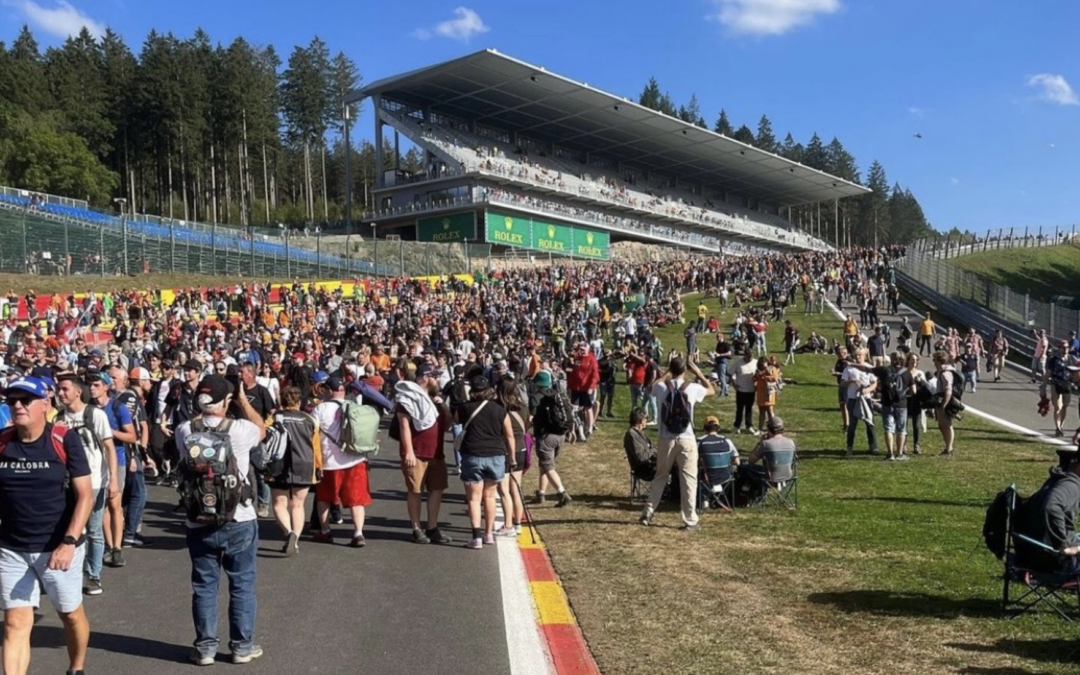
A racetrack that behaves like a forest spirit and occasionally tries to kill you
Spa-Francorchamps isn’t just a Formula One circuit. It’s a mood. A personality. A temperamental artist hidden in the Ardennes Forest who doesn’t care about your plans, your weather radar, or your confidence heading into Eau Rouge. Drivers call it one of the greatest circuits in the world. Fans call it a pilgrimage. Meteorologists call it “a problem.”
But to understand why Spa is so beloved, you have to go back to the beginning.
Born From Three Country Roads (1921)
The earliest version of Spa was created by connecting public roads between Francorchamps, Malmedy, and Stavelot. The loop was long — 14.9 km — and fast. Before modern safety standards even existed, drivers hurled themselves down tree-lined straights with nothing but a leather cap and the hope that Belgium liked them.
The first event was supposed to be a motorcycle race, but the riders took one look at the track and declined. Cars were sent out instead — which instantly set the tone for Spa as a place where logic rarely wins.
Spa’s Golden (and Terrifying) Era
By the 1930s and 1940s, Spa gained a reputation as a horsepower playground. It was beautiful, but brutally dangerous. So dangerous that some of the sport’s greatest legends have stories tied here — stories fans still tell with a reverent shake of the head.
Jackie Stewart’s 1966 Crash: The Safety Revolution
One of the most defining moments in Spa’s history happened in 1966.
Jackie Stewart, already a rising star, crashed at high speed in heavy rain. His BRM slammed into a telephone pole, then a farmhouse, trapping him upside down in the car as fuel poured over him.
There were no track marshals with tools. No medical crew with extraction gear.
Two fellow drivers — Bob Bondurant and Graham Hill — had to borrow a spectator’s spanner to free him.
Stewart survived, but the crash changed everything. It triggered his lifelong campaign for safety in Formula One and became one of the strongest reasons the original Spa layout was reevaluated. Stewart later said Spa was the “most frightening track” he’d ever raced.
Jim Clark’s Dominance (and Dislike) of Spa
Jim Clark, one of the smoothest drivers in history, absolutely dominated Spa.
He won four Belgian Grands Prix in a row (1962–1965).
But here’s the twist — he hated racing there. The speeds were astronomical, the conditions unpredictable, and the danger constant. He once said driving Spa in the rain felt like “steering a speedboat across a plowed field.”
His mastery and his discomfort perfectly sum up the original circuit’s allure: irresistible but unsettling.
The Weather That Writes Its Own Plot Twists
Spa is infamous for microclimates. The Ardennes can rain on one corner while serving sunshine on another. This isn’t an exaggeration — it’s a longstanding joke in the paddock.
1998: The Crash That Looked Like Bowling
The 1998 Belgian Grand Prix delivered one of the most spectacular and chaotic accidents in F1 history.
A downpour hit just as the race began. Visibility dropped. Cars slid. And before anyone could blink:
Thirteen cars piled into each other on Lap 1.
Carbon fiber everywhere. Mechanics sprinting. Commentators screaming.
Miraculously, no one was seriously injured. But the restart wasn’t much kinder — Michael Schumacher collided with David Coulthard in a moment that still fuels pub debates.
The Great Shrinking of Spa (1979)
By the late 1970s, the sport acknowledged it couldn’t keep sending drivers down 9-mile stretches bordered by stone houses and drainage ditches. So Spa was shortened to a 7 km permanent circuit in 1979.
The new layout kept the magic and the speed but introduced modern safety features.
Eau Rouge & Raidillon Become Icons
Two corners cemented Spa’s myth: Eau Rouge and Raidillon.
Drivers rocket downhill, sweep left, then snap right up a steep hill at full throttle. Cameras can’t capture the elevation change. Fans can’t see the apex. Drivers can’t see much of anything.
It’s the closest Formula One gets to a religious experience.
In 1999, Mika Häkkinen made his legendary double overtake on Michael Schumacher here — a move often ranked as the greatest in F1 history. He used Ricardo Zonta’s backmarker position to slingshot past Schumacher at full speed. It was bold, brilliant, and so perfectly Spa.
Spa in the Modern Era: Still Chaotic, Still Magic
Even with its updates, Spa remains unpredictable.
2008: The Rain-Soaked, Rule-Soaked Controversy
Lewis Hamilton and Kimi Räikkönen produced one of Spa’s greatest duels — sliding, switching positions, and drifting through wet corners like they were auditioning for a heist film.
Hamilton crossed the line first, but stewards slapped him with a 25-second penalty for cutting a chicane during the battle. The decision remains one of the most debated calls in F1 history.
2021: The Race That Wasn’t
Spa also delivered the shortest “race” in F1 history.
In 2021, relentless rain made driving impossible.
After hours of delays, officials sent cars out for two safety-car laps solely to meet the legal definition of a race.
Fans sat in ponchos for seven hours. Drivers shrugged.
George Russell got a podium without ever racing a single lap at speed — peak Spa chaos.
Why Spa Endures
It’s no secret, tragedies have struck SPA, but the race endures. With all its quirks, weather tantrums, crashes, and heroic moments, Spa remains the soul of Formula One.
Because no other track combines:
• massive elevation changes
• forests that feel alive
• corners that demand bravery over horsepower
• and history packed with human moments — terrifying, triumphant, and unforgettable
Spa doesn’t just host races. It shapes careers.
It tests courage.
It humbles champions.
And every once in a while, it delivers a story that becomes part of Formula One mythology.